
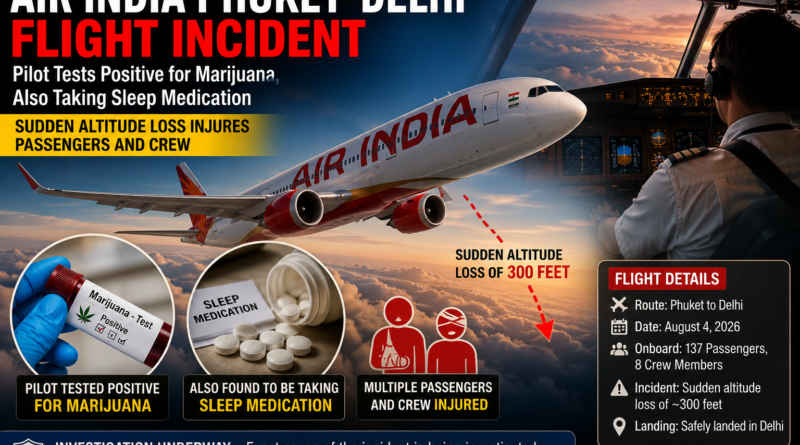
Air India Phuket–Delhi Flight Incident Raises Serious Questions Over Pilot Fitness and Aviation Safety
A recent incident involving an Air India flight travelling from Phuket to Delhi has raised serious concerns about aviation safety, pilot fitness, and airline screening procedures. The aircraft reportedly experienced a sudden loss of approximately 300 feet in altitude during the flight, leaving passengers and crew members injured. Subsequent reports stated that the pilot-in-command tested positive for marijuana in a confirmatory drug test and was also reportedly taking prescribed medication for sleep-related difficulties.
The incident is now under investigation, and it is important to separate confirmed information from allegations. A positive test alone does not automatically establish the exact cause of the altitude loss. Investigators will need to examine cockpit procedures, aircraft systems, weather conditions, crew actions, medical information, and flight-recording data before reaching a final conclusion. However, the reported findings have created major concerns because pilots are responsible for the safety of hundreds of lives during every flight.
What Happened During the Phuket–Delhi Flight?
The Air India flight, operating from Phuket to Delhi on August 4, reportedly experienced a sudden change in altitude while cruising over India. Reports indicate that the aircraft lost around 300 feet of altitude before the situation was brought under control. The flight ultimately landed safely in Delhi.
The aircraft was carrying 137 passengers and eight crew members. Reports differ slightly regarding the exact number of people injured, but multiple passengers and crew members reportedly suffered injuries during the sudden movement of the aircraft. Reuters reported injuries to passengers and crew, while Indian media reports have described a higher total of people affected.
A sudden altitude change can be dangerous, particularly when passengers or crew members are standing, walking through the cabin, or not wearing seatbelts. Even a relatively short altitude loss can cause injuries if people are thrown against seats, overhead compartments, or other parts of the aircraft.
The central question now is what caused the altitude variation and whether any human, technical, or environmental factors contributed to the incident.
Pilot’s Confirmatory Drug Test Raises Serious Concerns
The investigation became more serious after reports emerged that the pilot-in-command had tested positive for marijuana. According to Reuters, the captain’s confirmatory laboratory test returned positive, following initial testing after the flight. Indian authorities subsequently sought information regarding the incident and its investigation.
This development is significant because commercial pilots are expected to meet strict standards regarding physical and mental fitness. Operating a passenger aircraft requires constant attention, rapid decision-making, situational awareness, and the ability to respond immediately to unexpected situations.
However, an important distinction must be made: a positive marijuana test does not, by itself, prove that marijuana caused the altitude loss or that the pilot was impaired at the exact moment of the incident. That connection can only be established through a detailed investigation using medical evidence, toxicology results, cockpit recordings, flight data, and other relevant information.
Therefore, it would be premature to declare the cause of the incident before investigators release their conclusions.
Reports of Sleep Medication Add Another Layer to the Investigation
The situation became even more concerning after reports indicated that the pilot was also taking prescribed medication related to sleep difficulties. NDTV and other Indian media outlets reported this additional detail.
Sleep-related medication can be medically prescribed and legitimate. But aviation authorities generally place strict restrictions on medications that could affect alertness, reaction time, judgment, or cognitive performance.
This does not automatically mean the medication caused any problem during the flight. The exact type of medication, dosage, timing, medical approval, and its possible effects would need to be examined by investigators.
The combination of these reported findings has nevertheless raised a broader question: Were existing pilot fitness and medical monitoring systems sufficient to identify potential risks before the aircraft entered service?
Why Pilot Fitness Is Critical for Aviation Safety
Commercial aviation is built around multiple layers of safety. Modern aircraft have sophisticated automated systems, highly trained pilots, air traffic control, maintenance teams, and strict operating procedures.
However, technology does not eliminate the importance of human performance.
Pilots must remain capable of making decisions during emergencies, system failures, severe weather, medical issues, or unexpected aircraft behaviour. Fatigue, medication, alcohol, drugs, illness, or psychological stress can potentially affect human performance.
That is why airlines and aviation regulators have strict procedures concerning:
-
Medical fitness of pilots
-
Alcohol and substance testing
-
Medication disclosure
-
Rest and fatigue management
-
Pre-flight fitness assessments
-
Post-incident investigations
-
Random or mandatory screening procedures
The Phuket–Delhi incident could lead to renewed scrutiny of how these systems are implemented, particularly for international flights departing from locations where screening procedures may differ.
Investigation Must Determine the Actual Cause
The most important point is that the investigation should not jump to conclusions.
The aircraft’s sudden altitude loss could potentially involve several factors, including pilot actions, turbulence, automation, technical issues, or other operational circumstances. Flight data recorders and cockpit voice recordings, along with aircraft maintenance records and crew interviews, will be critical in determining what actually happened.
The presence of marijuana in a pilot’s confirmatory test is clearly a serious issue from a professional and regulatory perspective. But connecting that result directly to the altitude loss requires evidence.
Aviation investigations are supposed to establish facts, not simply find someone to blame.
Conclusion
The Phuket–Delhi Air India incident is a serious aviation safety event because passengers and crew members were injured after the aircraft experienced a sudden loss of altitude. The subsequent reports regarding the pilot-in-command’s positive marijuana test and use of prescribed sleep medication have intensified concerns about pilot fitness and safety monitoring.
At the same time, the investigation is still crucial. A positive drug test should not automatically be presented as the proven cause of the altitude loss unless investigators establish that connection through evidence.
The final investigation will need to answer several important questions: What caused the sudden altitude change? Were proper cockpit procedures followed? Did any medical or physiological factors affect pilot performance? Were airline and regulatory screening systems adequate?
Until those questions are answered, the most responsible conclusion is simple: this incident has exposed potentially serious concerns that deserve a thorough, evidence-based investigation, not speculation.